

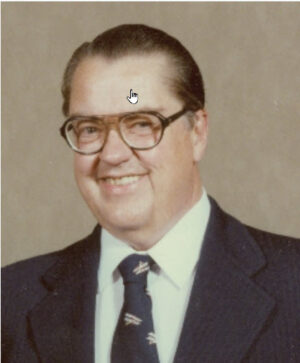
 In 1973, an IBM engineer named George Joseph Laurer did something that would quietly reshape the way the entire world buys and sells things. He designed the Universal Product Code — a simple pattern of black bars and white spaces that could be printed on any product and read by a scanner in a fraction of a second. Fifty-three years later, that invention is still scanning billions of items every single day.
George Laurer and the making of the UPC
Laurer spent 36 years at IBM before retiring in June 1987. During that time he earned 25 patents and authored 20 published Technical Disclosure Bulletins. IBM recognized him with numerous honors, including the prestigious Raleigh, N.C. Inventor of the Year award in 1976, and the IBM Corporate Technical Achievement Award in 1980 for his work on the UPC. He passed away in December 2019 at the age of 94, leaving behind a legacy that touches every cashier, warehouse, and shipping dock on earth.
Before coming to IBM, Laurer earned a B.S. in electrical engineering from the University of Maryland in 1951 — a path that began after he served in World War II and was encouraged by a technical school instructor to pursue a full engineering degree rather than stop at radio and TV repair.
How the UPC came to be
Commercial barcodes had existed in limited form since the mid-1960s, but they lacked standardization. Around 1970, McKinsey & Co., working with the Uniform Grocery Product Code Council (UGPCC) — a body formed by the grocery industry’s major trade associations — set out to define a universal numeric format for product identification. They issued a challenge to companies across the industry: design the best code, the best symbol, and provide full specifications for both.
The request went out to Singer, National Cash Register, Litton Industries, RCA, Pitney-Bowes, IBM, and a number of smaller firms. Most of the competing companies already had optical codes and scanning equipment in the marketplace. IBM did not. That was actually an advantage: in 1971, Laurer was handed the assignment with a blank slate, tasked with designing the single best code and symbol for the grocery industry from the ground up.
He conceived the approach and built out the symbol. Two colleagues joined him to calculate readability theoretically and prepare IBM’s formal proposal. They submitted three versions, incorporating minor changes requested by the UGPCC — including an extension to eleven digits and a “zero suppressed” variant. All contenders were then evaluated by the Battelle Memorial Institute. Laurer played a central role in designing the scanning equipment used in that evaluation and was awarded several patents for the methods used in detecting, decoding, and correcting barcode reads.
In May of 1973, IBM’s proposal was accepted. The UGPCC requested only two modifications: a different type font for the human-readable digits and an adjusted ink contrast specification. Everything else was Laurer’s design, essentially unchanged.
June 26, 1974: the first scan
The Universal Product Code went live commercially on June 26, 1974, when a barcode scanner was installed in a Marsh Supermarket in Troy, Ohio. The first product ever scanned was a 10-pack of Wrigley’s Juicy Fruit gum. That pack of gum is now on display at the Smithsonian Institution’s National Museum of American History in Washington, D.C.
That moment didn’t look like much at the time. But it was the beginning of the end of manual price-sticker systems, the foundation of modern inventory management, and the starting point for the entire global supply chain infrastructure we depend on today.
52 years of scanning — and still going strong
The UPC-A barcode introduced in 1973 is still the dominant format in the United States and Canada. Its 13-digit cousin, the EAN-13, is the international standard used throughout Europe, Asia, Australia, and South America. The two formats are technically interchangeable — modern scanners read both — and the underlying structure Laurer designed has proven so robust that no one has found reason to replace it at the retail level.
Today, more than six billion barcodes are scanned worldwide every single day. The format has expanded well beyond grocery shelves into pharmaceuticals, publishing, logistics, music distribution, digital goods, and virtually every other product category imaginable. QR codes and RFID tags have emerged as complementary technologies, but the humble 1D barcode remains the universal language of commerce.
What it means for you
If you’re here, you’re probably looking to get barcodes for your own products — and you’re benefiting directly from the work George Laurer did more than five decades ago. The UPC and EAN numbers Nationwide Barcode sells are part of that same GS1-originated system, issued under prefixes we’ve held since before 2002. When you put one of our barcodes on your product, you’re connecting to the same infrastructure that started with a pack of gum in Troy, Ohio in 1974.
Not bad for a 53-year-old invention.